 by
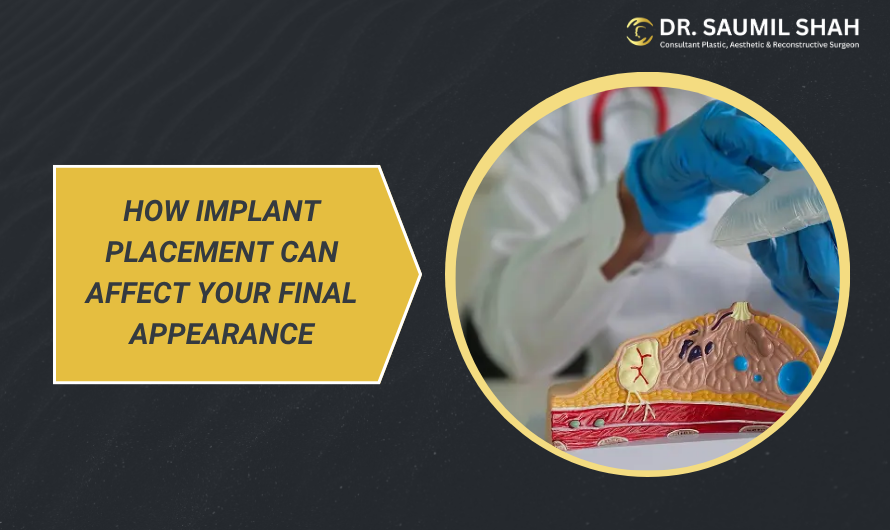
by When considering breast augmentation, most patients focus on implant size and shape. However, where the breast implant is placed can also have a significant effect on how the breasts look and feel after surgery. Implant placement can influence upper-breast fullness, breast contour, cleavage, the transition between the chest and breast, and how natural the final result appears.
If you are considering Breast Augmentation Surgery in Mumbai, understanding the difference between implant placement options can help you have a more informed discussion with your plastic surgeon. Dr. Saumil Shah can assess your existing breast tissue, chest anatomy, skin quality, and aesthetic goals before recommending an appropriate implant position.
What Does Breast Implant Placement Mean?
Breast implant placement refers to the position of the implant relative to the chest muscle, particularly the pectoralis major muscle.
The two commonly discussed options are:
- Above the muscle (subglandular placement): The implant sits behind the breast tissue but in front of the chest muscle.
- Partially or fully below the muscle: The implant is positioned beneath the pectoralis muscle to varying degrees.
There are also techniques that combine tissue planes, sometimes referred to as dual-plane placement. The appropriate approach depends on the patient’s anatomy rather than being a one-size-fits-all decision.
Why Does Implant Placement Matter?
Two women may choose implants with similar volume but achieve noticeably different appearances because their implants are positioned differently.
Placement can affect:
- Upper-pole fullness
- Breast contour
- Cleavage appearance
- Visibility or palpability of the implant
- The transition between the chest and breast
- How the implant interacts with existing breast tissue
- Animation of the breast during muscle contraction
- Overall proportions and symmetry
This is why choosing an implant is not simply about selecting a number of cubic centimetres or a particular cup size.
Implant Placement Above the Muscle
With subglandular placement, the implant is positioned underneath the existing breast tissue but above the pectoralis muscle.
Potential appearance-related advantages
This placement may provide:
- More direct projection of the implant
- Less movement of the implant when the chest muscle contracts
- A potentially more pronounced upper-breast appearance
- A shorter or different recovery experience for some patients
However, the visual result depends heavily on how much natural breast tissue is available to cover the implant.
Who may be suited to this placement?
Patients with adequate natural breast tissue may sometimes be suitable for an implant placed above the muscle. However, this decision needs to be based on individual anatomy.
If there is limited soft-tissue coverage, the implant edges or rippling may be more noticeable in some patients.
Implant Placement Below the Muscle
With submuscular or muscle-covered placement, the implant is positioned beneath the pectoralis muscle to provide additional soft-tissue coverage in the upper part of the breast.
This can be useful for patients who have relatively little natural breast tissue.
How can it affect appearance?
Muscle coverage may create a smoother transition between the chest and upper breast, particularly in patients with a thinner build.
It can help reduce the abrupt appearance of an implant in the upper portion of the breast in appropriately selected patients.
However, the muscle does not completely cover every part of the implant, and the final appearance still depends on the patient’s breast tissue, implant characteristics, and surgical technique.
What Is Dual-Plane Implant Placement?
Dual-plane breast augmentation is a technique in which the upper portion of the implant receives coverage from the pectoralis muscle while the lower portion has greater contact with the breast tissue.
The exact technique can vary depending on the patient’s anatomy.
A dual-plane approach may be considered when the surgeon wants to balance:
- Upper-pole coverage
- Breast projection
- Lower-pole expansion
- Natural-looking contours
- Existing breast tissue and skin characteristics
It can be particularly useful when the patient has some breast tissue but also needs additional coverage in the upper portion.
How Implant Placement Can Change Upper-Breast Fullness
One of the most noticeable differences between placement options can be the appearance of the upper portion of the breast.
Some patients prefer a fuller, more defined upper breast, while others want a gradual slope from the chest to the breast.
A surgeon needs to consider the patient’s:
- Chest width
- Existing breast volume
- Skin thickness
- Rib-cage shape
- Implant profile
- Implant volume
- Desired aesthetic appearance
The same implant can therefore produce different visual results in different patients.
Can Implant Placement Affect Cleavage?
Implant placement can influence the overall shape and position of the breasts, but implant placement alone cannot guarantee a particular cleavage appearance.
Cleavage depends on several factors, including:
- Natural breast position
- Breast width
- Chest anatomy
- Distance between the breasts
- Implant width
- Implant volume
- Implant profile
- Existing breast tissue
It is important to understand that implants cannot completely change the underlying anatomy of the chest.
A surgeon can position the implants to create appropriate proportions while maintaining safe tissue boundaries, but forcing implants too close together may create an unnatural appearance or other complications.
Implant Placement and a Natural-Looking Result
Many patients want their augmentation to look noticeable while still appearing proportionate.
For a natural-looking result, implant placement needs to work together with implant selection.
Important considerations include:
1. Existing breast tissue
Patients with more natural tissue may have greater coverage over the implant.
Patients with thin breast tissue may require a strategy that provides additional soft-tissue coverage.
2. Skin elasticity
Skin that has good elasticity may respond differently to an implant than skin that has stretched significantly.
3. Implant size
A larger implant places greater demands on the available tissue and skin.
Choosing an implant that is too large for the patient’s anatomy can affect the final contour regardless of placement.
4. Implant profile
Implant profile determines how far the implant projects from the chest.
A high-profile implant, for example, can create a different appearance from a lower-profile implant even when the overall volume is similar.
5. Breast shape
The starting shape of the breasts influences the final result. Implant placement must be planned around the patient’s existing anatomy rather than attempting to create an identical shape for everyone.
Can Implant Placement Affect Implant Visibility or Rippling?
Yes, implant visibility and rippling can be influenced by tissue coverage and implant characteristics.
Patients with thin soft-tissue coverage may be more likely to notice:
- Implant edges
- Rippling
- Palpability
- Contour irregularities
Placement beneath the muscle can provide additional coverage in certain areas, but it does not eliminate these possibilities completely.
The implant type, size, surface characteristics, breast tissue, and surgical technique can also influence the result.
What About Breast Movement During Exercise?
Patients who regularly exercise, especially those involved in activities that strongly contract the chest muscles, may have concerns about implant movement.
With implants positioned partially beneath the muscle, contraction of the pectoralis muscle can sometimes cause visible movement of the breast or implant. This phenomenon is commonly referred to as animation deformity.
The likelihood and degree can vary between patients.
For someone who performs frequent chest-focused training, this should be discussed during the consultation so that implant placement can be planned with lifestyle considerations in mind.
Can Implant Placement Correct Breast Asymmetry?
Breast augmentation can sometimes improve differences between the breasts, but implant placement is only one part of the correction.
Many women naturally have some degree of asymmetry involving:
- Breast volume
- Breast position
- Nipple position
- Breast shape
- Chest wall structure
- Skin quality
The surgeon may recommend different implant sizes or other adjustments depending on the degree and type of asymmetry.
Perfect symmetry cannot always be achieved because the underlying anatomy is naturally different from one side to the other.
What If You Have Sagging Breasts?
Implant placement alone may not adequately address significant breast sagging.
If the breast tissue has stretched or the nipple sits significantly lower on the breast, a breast lift may be considered along with augmentation.
This can help address two separate concerns:
- The implant adds volume.
- The lift reshapes and repositions the existing breast tissue.
Whether augmentation alone, a lift alone, or a combination is appropriate depends on the patient’s anatomy and goals.
Implant Placement Is Not the Same for Everyone
There is no single implant position that is universally appropriate.
For example:
A patient with thicker breast tissue may have several placement options.
A patient with very thin tissue may need to consider how implant coverage will affect visibility.
An athletic patient may need to discuss muscle activity and the possibility of animation.
A patient with significant breast sagging may require evaluation for a breast lift.
This is why copying another person’s implant choice or placement is not necessarily appropriate.
How Does a Surgeon Decide the Right Implant Placement?
During a breast augmentation consultation, the surgeon may assess:
- Breast width
- Breast tissue thickness
- Skin elasticity
- Existing breast volume
- Nipple position
- Breast asymmetry
- Chest-wall anatomy
- Muscle development
- Lifestyle and exercise habits
- Desired breast shape
- Desired level of fullness
- Implant size and profile
Measurements and physical examination are important because photographs alone cannot determine the appropriate implant position.
Can Implant Placement Affect Recovery?
Yes. Different implant placement techniques can involve different effects on the surrounding tissues.
When the pectoral muscle is involved, patients may experience more muscle-related discomfort during the early recovery period.
Recovery also depends on:
- Surgical technique
- Implant size
- Individual healing
- Physical activity
- Whether other procedures are performed
- Postoperative care
Your surgeon should provide personalised instructions about exercise, sleeping position, support garments, wound care, and when normal activities can be resumed.
What Happens If the Implant Is Placed in the Wrong Position?
Implant position is carefully planned during surgery, but complications can still occur.
Possible issues can include:
- Implant displacement
- Asymmetry
- Visible implant edges
- Double-bubble deformity
- Changes in breast contour
- Capsular contracture
- Animation deformity
- Unwanted changes in breast shape
Not every postoperative difference means that the implant was “placed incorrectly.” Healing, tissue behaviour, implant characteristics, and changes over time can all influence the final appearance.
If a significant problem develops, revision surgery may sometimes be considered.
How Long Does It Take to See the Final Appearance?
The breasts do not usually look exactly as expected immediately after surgery.
During the early recovery period, you may experience:
- Swelling
- Tightness
- Temporary asymmetry
- Higher implant position
- Changes in breast shape
As swelling decreases and the tissues relax, the breasts generally settle into a more stable appearance.
The timeline varies between individuals, so your surgeon should guide you on what is normal during your recovery.
What Should You Discuss During Your Breast Augmentation Consultation?
Instead of focusing only on implant size, consider discussing the entire treatment plan.
Useful questions include:
- Which implant placement is appropriate for my anatomy?
- How much natural tissue do I have to cover the implant?
- What type of breast shape can I realistically achieve?
- Would placement under the muscle affect my exercise routine?
- Do I have breast asymmetry that needs to be addressed?
- Would I benefit from a breast lift as well?
- What implant size and profile are appropriate for my chest width?
- What are the potential risks of the recommended placement?
- How will the implants affect my breast shape over time?
- What should I expect during recovery?
A detailed consultation allows the surgeon to explain why a particular approach may be suitable for you.
Why Choosing the Right Surgeon Matters
Breast augmentation is not simply about inserting an implant. The surgeon needs to consider the relationship between the implant, breast tissue, skin, muscle, and chest anatomy.
An experienced plastic surgeon can evaluate these factors and develop an individualised surgical plan rather than relying on a standard implant placement for every patient.
If you are considering Breast Augmentation Surgery in Mumbai, consulting Dr. Saumil Shah can help you understand your implant options, including how placement may influence your final breast shape and overall proportions.
Frequently Asked Questions
Is breast implant placement more important than implant size?
Both matter. Implant size, profile, shape, placement, breast tissue, and chest anatomy all interact to influence the final appearance.
Is it better to place implants above or below the muscle?
Neither option is universally better. The appropriate position depends on your anatomy, tissue coverage, lifestyle, implant choice, and aesthetic goals.
Does placing an implant under the muscle make it look more natural?
It can provide additional coverage in the upper portion of the breast for some patients, particularly those with limited natural tissue. However, a natural appearance depends on multiple factors.
Can implants placed under the muscle move during exercise?
They can. Contraction of the pectoral muscle may cause temporary movement of the breast or implant in some patients.
Can implant placement affect cleavage?
It can influence overall breast positioning and contour, but cleavage also depends heavily on natural anatomy, breast width, implant dimensions, and existing breast position.
Can breast augmentation fix sagging?
Breast augmentation adds volume but does not necessarily correct significant sagging. Some patients may benefit from combining augmentation with a breast lift.
Can implant placement be changed later?
In some circumstances, revision surgery can change implant position or address complications. Whether this is appropriate depends on the individual’s anatomy and the reason for revision.
Final Thoughts
Implant placement can have an important influence on your final breast appearance, but it should never be considered separately from implant size, profile, breast tissue, skin quality, chest anatomy, and your personal goals. The right approach is the one that is planned around your individual anatomy rather than simply copying another patient’s result.
If you are considering Breast Augmentation Surgery in Mumbai, a consultation with Dr. Saumil Shah can help you understand which implant placement and implant characteristics may be appropriate for your body and the type of result you want to achieve.